

📍 South Florida, FL
Custom DTG Printing | South Florida
Full-color direct-to-garment printing on cotton tees, hoodies, and totes — photographic detail with no screens, no per-color charges, and no minimum. Printed in our Hallandale Beach shop for customers across Miami-Dade and Broward, with free proofs and free local pickup.
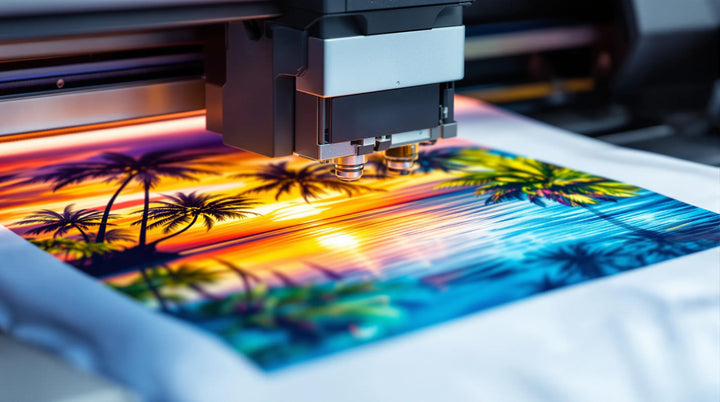
Custom DTG Printing in South Florida
DTG printing is what you reach for when the artwork has more colors in it than the order has shirts. A direct-to-garment printer is an industrial inkjet aimed at fabric: it lays water-based pigment ink straight into the fibers of the garment, one piece at a time, with no screens to burn and nothing to charge for per color. A photograph, a watercolor, a portrait, a logo with a gradient behind it — all of it prints for the same effort as a single word, and the twelfth shirt can carry a different name than the first without costing a cent more to set up. That is the trade DTG makes. It gives up the volume economics of screen printing and gets back the ability to print anything, once.
Adorb Custom Tees prints DTG in our own shop at 389 NE 2nd Ave in Hallandale Beach, sitting directly on the Miami-Dade and Broward line, which is why customers from Kendall to Coral Springs can drop off a file and collect finished shirts in the same week. There is no minimum here and no account to open — one memorial shirt is a normal order, and so is a fifty-piece retail run. Most DTG orders under twenty-five pieces are ready in two to four business days after you approve your proof, and because nothing has to be prepared overnight the way a screen does, print-ready artwork brought in early on a weekday can often be picked up the same afternoon. Free proofs, free local pickup, and if the artwork needs cleaning up before it prints well, that is part of the job rather than an upcharge.
How DTG Printing Works
Every DTG print begins with pretreatment, and that step decides whether the print survives its first month. A fine, even mist of pretreatment solution is sprayed across the print area and then pressed dry under heat. The solution itself is clear, not white — the white people associate with DTG comes later, out of the printer. What the pretreatment actually does is chemical: it carries positively charged polymers that seize the negatively charged pigment particles in the ink and hold them at the surface of the fibers instead of letting them wick sideways into the weave. The heat press does a second job at the same time, crushing the cotton's surface fuzz flat so the printhead has a smooth field to work on. Skip it, or apply it unevenly, and you get a soft, fuzzy, low-contrast print that fades in a handful of washes. Nearly every complaint anyone has ever had about DTG traces back to this step.
The garment is then laid flat on a platen that slides beneath a fixed printhead. On white and light shirts the printer goes straight to CMYK color. On a dark shirt it has to lay down a white ink underbase first — an opaque foundation printed in the exact shape of the design — and then print the color on top of it, because textile ink is translucent and navy ink on a navy shirt is simply invisible. That underbase is why dark garments take longer on press, cost a little more per piece, and read a shade softer than the same file printed on white. It is not a defect; it is physics, and it is worth knowing before you choose your blank.
Ink leaves the printer wet and has to be cured with heat — roughly 320°F to 330°F for about 60 to 90 seconds under a press or through a tunnel dryer. Curing drives off the water and bonds the pigment's resin binder into the cotton itself. Under-curing is the most common cause of a DTG print failing early, which is why we cure to temperature rather than to a stopwatch. A correctly cured print sits in the fabric rather than on top of it: no plastic panel, no stiff edge, no crack line when the shirt is pulled. Run a hand across a light-garment print and you feel the weave before you feel the graphic. That hand-feel is DTG's genuine advantage over every transfer-based method, where the design is a thin film resting on the surface.
Fabric decides the outcome more than the artwork does. Water-based ink needs absorbent fiber, so 100% cotton is the ideal substrate and ring-spun cotton is better still; cotton-heavy blends from about 50% cotton upward print reliably, with more cotton giving more color. Polyester is the opposite problem. Its fibers are non-porous synthetic filaments that repel water-based ink, so the ink beads rather than absorbs, cures unevenly, and much of what sat between the fibers washes away the first time the shirt goes through a machine. Tri-blends and 50/50s do print, but softer and more muted than pure cotton, because the rayon and polyester in them take ink differently than the cotton does — sometimes that vintage look is exactly what you want, and we will tell you which you are going to get. On the right blank, expect a DTG print to hold its color through roughly 30 to 50 wash cycles when the garment is washed inside out in cold water on a gentle cycle and dried low. That is a real, everyday-wear print. A heavy screen print will outlast it; almost nothing else will feel as good on.
See Your Design on the Shirt First
Send the artwork, the garment, and the quantity — a firm quote and a digital proof come back, usually the same day.
Get a Free QuoteWhat We Can DTG Print
DTG has a narrower ideal window than any other method we run, and being honest about that window is what keeps orders from disappointing. Inside it, nothing prints softer or in more color. These are the pieces we print most often:
- T-shirts and tanks — the core of it. Cotton and cotton-rich tees in white, natural, ash, and light heathers give the truest color; darks print well too, with the white underbase step.
- Hoodies and sweatshirts — cotton-heavy fleece, printed on the flat front or back panel. Pullovers work better than zip-ups, since a zipper cannot lie flat under the printhead.
- Tote bags and aprons — natural cotton canvas is an excellent DTG surface, and full-color art on a tote is one of the few places you get a photographic print with no color limit at all.
- Onesies, kids' and youth sizes — small cotton garments print cleanly and hold fine detail; artwork is simply scaled down to the size of the piece.
- One-off and personalized pieces — memorial shirts, family reunion sets where every back is a different name, birthday and celebration tees, a single shirt made from a phone photo. Personalization costs nothing extra on a DTG press because there is no setup to repeat.
- Small retail and merch runs — ten or twenty pieces of a full-color design for a shop, a band, a gym, or a new business testing artwork before committing to a bulk press run.
What DTG is not the right answer for is just as worth stating. Performance and athletic wear, 100% polyester, nylon, and anything water-resistant will not hold water-based ink properly — those belong on a DTF transfer, and structured caps belong on an embroidery machine. Anything with a seam, a pocket, a collar, or a zipper running through the print area is a problem too, because the garment has to lie perfectly flat and close to the printhead for the print to land sharp. There is also a size ceiling: the platen sets a maximum image of roughly 14 inches wide by 16 inches tall on adult sizes. And if you are ordering more than about two to three dozen of one simple design, screen printing will beat DTG on price and on wash life, and we will tell you so rather than take the larger DTG order.
Blank choice matters more here than most people expect, so we would rather help you pick one than print your file onto the wrong shirt. Ring-spun cotton tees like the ones in our Comfort Colors cotton tees collection are about as good a DTG surface as exists, and if you already have blanks in hand, bring one in — we can print a single test piece so you are judging the actual shirt instead of a mockup.
Find Your City
We print DTG for customers across Miami-Dade and Broward from one shop in Hallandale Beach. Pick your city below for the pickup, delivery, and drive-time details that actually apply to you.
Do not see your city on the list? We still almost certainly serve it — the pages above are the areas we get asked for most, not the limit of where we deliver. The full list is on our areas we serve page, and if you are anywhere in South Florida, just ask when you request your quote.
Pricing & Turnaround
Three things drive what a DTG order costs: the garment itself, how much area the design covers, and how many pieces you are running. The garment is the straightforward part — a basic cotton tee and a heavyweight hoodie are different products at different costs before anything is printed on them. Coverage is really a question of ink and press time, so a left-chest logo runs faster and cheaper than a full-front image bleeding to the edges of the platen, and a dark garment costs a little more than a light one because the white underbase is effectively a second print. Quantity moves the number, but far less than it does with other methods.
The part worth understanding is what is not on that list: color count. Screen printing charges a setup fee for every color in the design, because every color is a separate screen that has to be burned, aligned, and cleaned. DTG has no screens at all, so a twelve-color photograph and a one-color word cost exactly the same to print. That single fact is the whole pricing story. It is why a full-color design on five shirts is genuinely affordable here and would be absurd to screen print, and it is also why DTG stops making sense at volume: with no setup cost to spread out, the price barely falls as the count rises, while screen printing's setup gets cheaper per piece with every shirt added. The crossover usually lands somewhere around two to three dozen pieces of the same design, sooner for simple one- and two-color art. We quote both methods when your order sits near that line, and we recommend the one that is actually cheaper for you.
There is no minimum order. One shirt is a normal, welcome order, and it is priced like one shirt rather than penalized for being small. We also do not publish a price table, because a table has to assume the most expensive garment and the largest print in order to be safe, and quoting your real blank, your real artwork, and your real quantity almost always comes back lower than a generic figure would. Send what you have in mind and a firm, itemized quote comes back with nothing attached to it.
On timing: most DTG orders under twenty-five pieces are ready in two to four business days from artwork approval, and twenty-five to fifty pieces typically run three to five days depending on the queue. The clock starts when you approve the proof, not when you ask for the quote. Because DTG needs no overnight screen preparation, same-day is genuinely possible on smaller orders in stocked light cotton when print-ready artwork reaches us early in the day — call first so we can hold press time. Working toward a reunion, a game, a memorial service, or a market date? Tell us the date up front and we will build the schedule backward from it and say plainly whether it fits.
Ready to Print?
Request your free quote — most DTG orders are ready in two to four business days after proof approval, and there is no minimum.
Get a Free QuoteHow to Order Custom DTG Printing
Four steps, and nothing goes on press until you have approved a proof:
- Send us the design and the quantity. Use the free quote form or WhatsApp us at (954) 932-8543 with your artwork, the garment and colors you want, and how many. A 300 dpi PNG with a transparent background is ideal; a sharp photo or a PDF is fine too. If all you have is a rough idea or a low-resolution file, say so — getting artwork print-ready is part of the service, not a separate project.
- Review your quote and proof. A firm, itemized quote comes back with a digital proof showing your design at actual size on the actual garment color, usually the same day. If your quantity sits near the screen-printing crossover, you will get both prices so you can choose on facts rather than on our preference.
- Approve, and we print. Once you sign off, your order is pretreated, printed, and heat-cured in-house in Hallandale Beach. Most orders under twenty-five pieces are done in two to four business days, and personalized runs where each piece is different are printed individually so every name lands right.
- Pick it up or have it delivered. Free local pickup at 389 NE 2nd Ave, Hallandale Beach — or we will arrange local delivery across Miami-Dade and Broward, or ship it anywhere in the country.
Need the same shirts again next season? Your file stays with us, so a reorder runs from the approved artwork and comes back matching the last batch — and because there is no setup to redo, reordering three is as reasonable as reordering thirty. Questions before you send anything? Call (954) 932-8543 and ask; we would rather talk you into the right method than sell you the wrong one.
Solicita tu Cotización Gratis
Entrega rápida, precios competitivos, entrega local gratis en South Florida.
Solicita una CotizaciónRequest a Custom DTG Printing Quote — South Florida
Tell us about your order and we'll get back to you within 1 business day.
Custom DTG Printing in South Florida — frequently asked questions
Hay un pedido mínimo para el estampado DTG?
No. El DTG no lleva mallas ni montaje, así que no hay nada que repartir entre una cantidad mínima — una camiseta es un pedido completamente normal aquí, cotizado como una camiseta. Donde la cantidad sí importa es en el otro extremo: el precio del DTG casi no baja conforme sube el número, así que en cuanto pasas más o menos de dos a tres docenas de piezas del mismo diseño, la serigrafía normalmente cuesta menos por camiseta y dura más al lavado. Dinos tu cantidad y cotizamos ambos y te señalamos el más barato.
Sobre qué prendas y telas pueden estampar con DTG?
El DTG usa tinta al agua, que necesita fibra absorbente, así que el algodón 100% es lo ideal y el algodón peinado (ring-spun) es todavía mejor. Las mezclas con mucho algodón, de más o menos 50% de algodón en adelante, se estampan de forma confiable, y más algodón significa color más rico. Eso cubre camisetas, tops sin mangas, hoodies y sudaderas de algodón, mamelucos, delantales y bolsas tote de lona de algodón. No cubre el poliéster 100%, la ropa técnica que absorbe la humedad, el nailon ni nada repelente al agua — las fibras sintéticas repelen la tinta y buena parte se lava. Esos trabajos se van a transferencias DTF o a bordado, y te lo decimos cuando preguntes.
Cuánto tarda el estampado DTG?
La mayoría de los pedidos de menos de veinticinco piezas está lista en dos a cuatro días hábiles después de que apruebas tu prueba, y los de veinticinco a cincuenta piezas normalmente tardan de tres a cinco días según la fila. El tiempo arranca en la aprobación de la prueba, no en la solicitud de cotización. Como el DTG no necesita preparación de mallas de un día para otro, la recogida el mismo día es realista en pedidos chicos sobre algodón claro en inventario cuando el arte listo para estampar nos llega temprano en el día — llámanos antes para apartarte tiempo de máquina.
Debería elegir DTG, serigrafía o DTF?
Elige DTG para arte a todo color, fotográfico o con degradados sobre algodón, para piezas sueltas y personalizadas donde cada camiseta es distinta, y siempre que quieras el tacto más suave posible — la tinta tiñe las fibras, así que sientes la camiseta y no el gráfico. Elige serigrafía por encima de más o menos dos a tres docenas de piezas de un diseño simple, donde el montaje por color se paga solo y el depósito más grueso de tinta dura más que cualquier otra cosa al lavado. Elige DTF cuando la prenda sea de poliéster, de tela técnica, un tri-blend oscuro o un pedido con telas mezcladas, ya que una transferencia DTF se aplica a casi cualquier cosa — a cambio de una película fina que se siente en la superficie. Hacemos los tres, así que la recomendación no es un argumento de venta.
Qué zonas atienden?
Estampamos para clientes de todo Miami-Dade y Broward desde nuestro taller en 389 NE 2nd Ave, en Hallandale Beach, que queda justo sobre la línea entre condados — cómodo en las dos direcciones. Cada ciudad que atendemos tiene su propia página de DTG con los detalles de recogida y entrega local, así que elige la tuya de la lista de esta página o mira la lista completa en nuestra página de zonas que atendemos. También enviamos a todo el país cuando la recogida no es práctica.
Cuánto va a durar un estampado DTG y cómo debo lavarlo?
Sobre una prenda de algodón bien pretratada y completamente curada, espera que un estampado DTG conserve su color a lo largo de más o menos 30 a 50 ciclos de lavado de uso normal. Para llegar a la parte alta de ese rango: espera al menos 24 horas después de estampar antes del primer lavado, voltea la prenda al revés, lava en frío en ciclo suave con un detergente suave y sin blanqueador, seca en bajo o cuelga a secar, y nunca planches directamente sobre el estampado. Un ligero suavizado después del primer lavado es normal — es el pretratamiento residual enjuagándose, no el estampado fallando.
Nuestro taller
Visita nuestro taller en Hallandale Beach
389 NE 2nd Ave, Hallandale Beach, FL 33009
Recogida y entrega de pedidos en el taller, justo sobre la línea entre Miami-Dade y Broward.
Order Custom DTG Printing in South Florida today
Call, WhatsApp, or fill out the quote form. We'll handle the rest — artwork, printing, and local pickup.
