

📍 South Florida, FL
DTG Printing in South Florida, Explained
DTG printing, explained: what it is, when it makes sense, and why Adorb prints the same full-color orders with DTF instead. Adorb doesn't run DTG printers. Pickup at our Hallandale Beach shop; most orders ready in 1 to 10 days, depending on order size.
DTG Printing in South Florida, Explained
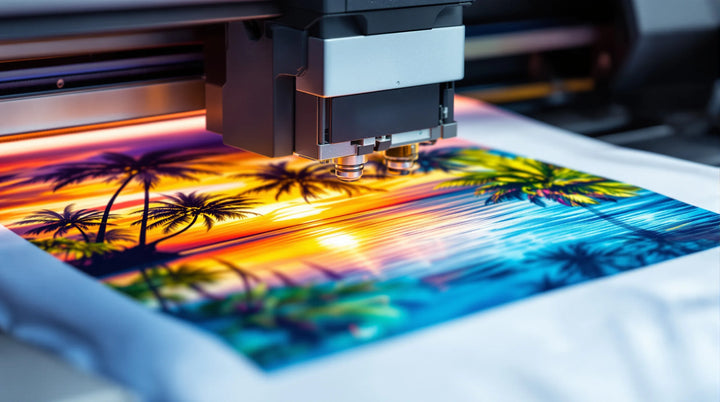
DTG printing is what you reach for when the artwork has more colors in it than the order has shirts. A direct-to-garment printer is an industrial inkjet aimed at fabric: it lays water-based pigment ink straight into the fibers of the garment, one piece at a time, with no screens to burn and nothing to charge for per color. A photograph, a watercolor, a portrait, a logo with a gradient behind it — all of it prints for the same effort as a single word, and the twelfth shirt can carry a different name than the first without costing a cent more to set up. That is the trade DTG makes. It gives up the volume economics of screen printing and gets back the ability to print anything, once.
People across Miami-Dade and Broward search for DTG when they want a photo, a gradient or a different name on every shirt, and those are exactly the jobs DTG was built for. Adorb doesn't run DTG printers. For the same full-color designs we print DTF transfers in our Hallandale Beach shop, on cotton and on the polyester and blends DTG can't handle, with no minimum. One memorial shirt is a normal order, and so is a fifty-piece retail run. Most orders are ready in 1 to 10 days, depending on order size, with free proofs and free local pickup at 389 NE 2nd Ave, right on the Miami-Dade and Broward line; if the artwork needs cleaning up before it prints well, that is part of the job.
How DTG Printing Works
Every DTG print begins with pretreatment, and that step decides whether the print survives its first month. A fine, even mist of pretreatment solution is sprayed across the print area and then pressed dry under heat. The solution itself is clear, not white — the white people associate with DTG comes later, out of the printer. What the pretreatment actually does is chemical: it carries positively charged polymers that seize the negatively charged pigment particles in the ink and hold them at the surface of the fibers instead of letting them wick sideways into the weave. The heat press does a second job at the same time, crushing the cotton's surface fuzz flat so the printhead has a smooth field to work on. Skip it, or apply it unevenly, and you get a soft, fuzzy, low-contrast print that fades in a handful of washes. Nearly every complaint anyone has ever had about DTG traces back to this step.
The garment is then laid flat on a platen that slides beneath a fixed printhead. On white and light shirts the printer goes straight to CMYK color. On a dark shirt it has to lay down a white ink underbase first — an opaque foundation printed in the exact shape of the design — and then print the color on top of it, because textile ink is translucent and navy ink on a navy shirt is simply invisible. That underbase is why dark garments take longer on press, cost a little more per piece, and read a shade softer than the same file printed on white. It is not a defect; it is physics, and it is worth knowing before you choose your blank.
Ink leaves the printer wet and has to be cured with heat, roughly 320°F to 330°F for about 60 to 90 seconds under a press or through a tunnel dryer. Curing drives off the water and bonds the pigment's resin binder into the cotton itself, and under-curing is the most common cause of a DTG print failing early. A correctly cured print sits in the fabric rather than on top of it: no plastic panel, no stiff edge, no crack line when the shirt is pulled. Run a hand across a light-garment print and you feel the weave before you feel the graphic. That hand-feel is DTG's genuine advantage over transfer-based methods, where the design is a thin film resting on the surface.
Fabric decides the outcome more than the artwork does. Water-based ink needs absorbent fiber, so 100% cotton is the ideal substrate and ring-spun cotton is better still; cotton-heavy blends from about 50% cotton upward print reliably, with more cotton giving more color. Polyester is the opposite problem: its fibers repel water-based ink, so the ink beads rather than absorbs, cures unevenly, and washes out. Tri-blends and 50/50s do print, but softer and more muted than pure cotton. That fabric limit is one reason we print DTF instead: a DTF transfer bonds to cotton, polyester, blends and performance wear alike.
See Your Design on the Shirt First
Send the artwork, the garment, and the quantity: a firm quote and a digital proof for your DTF print come back, usually the same day.
Get My PrintingWhat Can Be DTG Printed
DTG has a narrow ideal window, and knowing it keeps orders from disappointing. Inside it, few methods print softer or in more color. These are the pieces people DTG print most often:
- T-shirts and tanks — the core of it. Cotton and cotton-rich tees in white, natural, ash, and light heathers give the truest color; darks print well too, with the white underbase step.
- Hoodies and sweatshirts — cotton-heavy fleece, printed on the flat front or back panel. Pullovers work better than zip-ups, since a zipper cannot lie flat under the printhead.
- Tote bags and aprons — natural cotton canvas is an excellent DTG surface, and full-color art on a tote is one of the few places you get a photographic print with no color limit at all.
- Onesies, kids' and youth sizes — small cotton garments print cleanly and hold fine detail; artwork is simply scaled down to the size of the piece.
- One-off and personalized pieces — memorial shirts, family reunion sets where every back is a different name, birthday and celebration tees, a single shirt made from a phone photo. Personalization adds no setup on a DTG printer, and the same is true of a DTF transfer, which is how we print these.
- Small retail and merch runs — ten or twenty pieces of a full-color design for a shop, a band, a gym, or a new business testing artwork before committing to a bulk press run.
What DTG is not the right answer for is just as worth stating. Performance and athletic wear, 100% polyester, nylon, and anything water-resistant will not hold water-based ink properly; those belong on a DTF transfer, and structured caps belong on an embroidery machine. Anything with a seam, a pocket, a collar, or a zipper running through the print area is a problem too, because the garment has to lie flat under the printhead. There is also a size ceiling of roughly 14 by 16 inches on adult sizes, and on bigger runs of one simple design, DTG's per-piece price barely falls as the count rises.
Blank choice matters more than most people expect, so we would rather help you pick one than print your file onto the wrong shirt. Ring-spun cotton tees like the ones in our Comfort Colors cotton tees collection take a print beautifully, and if you already have blanks in hand, bring one in so we can talk through how your design will look printed with DTF.
Find Your City
We print full-color DTF for customers across Miami-Dade and Broward from one shop in Hallandale Beach. Pick your city below for the pickup, delivery, and drive-time details that apply to you.
Do not see your city on the list? We still almost certainly serve it — the pages above are the areas we get asked for most, not the limit of where we deliver. The full list is on our areas we serve page, and if you are anywhere in South Florida, just ask when you request your quote.
Pricing & Turnaround
Three things drive what a DTG order costs: the garment itself, how much area the design covers, and how many pieces are being run. Coverage is a question of ink and press time, so a left-chest logo runs faster and cheaper than a full-front image, and a dark garment costs a little more than a light one because the white underbase is effectively a second print. Quantity moves the number, but far less than it does with other methods.
The part worth understanding is what is not on that list: color count. Screen printing charges a setup for every color, because every color is a separate screen. DTG has no screens, so a twelve-color photograph and a one-color word cost the same to print, which is why a full-color design on five shirts is affordable with DTG and would be absurd to screen print. DTF shares that advantage, and it is how we print full-color orders: no per-color setup, any fabric, any quantity.
There is no minimum order with us. One shirt is a normal, welcome order, and it is priced like one shirt rather than penalized for being small. We do not publish a price table, because quoting your real blank, your real artwork and your real quantity almost always comes back lower than a generic figure. Send what you have in mind and a firm, itemized quote comes back with nothing attached to it.
On timing: most of our orders are ready in 1 to 10 days, depending on order size, and the clock starts when you approve the proof, not when you ask for the quote. Working toward a reunion, a game, a memorial service, or a market date? Tell us the date up front and we will build the schedule backward from it and say plainly whether it fits.
Ready to Print?
Request your free quote: most orders are ready in 1 to 10 days, depending on order size, and there is no minimum.
Get My PrintingHow to Order Your Printing
Four steps, and nothing is printed until you have approved a proof:
- Send us the design and the quantity. Use the free quote form or WhatsApp us at (954) 932-8543 with your artwork, the garment and colors you want, and how many. A 300 dpi PNG with a transparent background is ideal; a sharp photo or a PDF is fine too. If all you have is a rough idea or a low-resolution file, say so — getting artwork print-ready is part of the service, not a separate project.
- Review your quote and proof. A firm, itemized quote comes back with a digital proof showing your design at actual size on the actual garment color, usually the same day.
- Approve, and we print. Once you sign off, your design is printed as DTF transfers and heat-pressed in-house in Hallandale Beach. Most orders are ready in 1 to 10 days, depending on order size, and personalized runs where each piece is different are printed individually so every name lands right.
- Pick it up or have it delivered. Free local pickup at 389 NE 2nd Ave, Hallandale Beach — or we will arrange local delivery across Miami-Dade and Broward, or ship it anywhere in the country.
Need the same shirts again next season? Your file stays with us, so a reorder runs from the approved artwork and comes back matching the last batch, and reordering three is as reasonable as reordering thirty. Questions before you send anything? Call (954) 932-8543 and ask.
Get Your Custom Printing Quote
Fast turnaround, competitive pricing, free local delivery in South Florida.
Request a QuoteRequest a Custom Printing Quote — South Florida
Tell us about your order and we'll get back to you within 1 business day.
Custom DTG Printing in South Florida — frequently asked questions
Is there a minimum order for DTG printing?
DTG has no screens, so it carries no setup minimum, which is why it is popular for one-off shirts. Adorb doesn't run DTG. We print DTF transfers, which also need no screens, so there is no minimum with us either: one shirt is a normal order.
What garments and fabrics can be DTG printed?
DTG uses water-based ink, which needs absorbent fiber, so 100% cotton is ideal and ring-spun cotton is better still. Cotton-heavy blends from about 50% cotton upward print reliably. That covers t-shirts, tanks, cotton hoodies and sweatshirts, onesies, aprons, and cotton canvas tote bags. It does not cover 100% polyester, moisture-wicking performance wear, nylon, or anything water-resistant. The DTF transfers we print, and our embroidery, cover those garments too.
How long does an order take?
Most of our orders are ready in 1 to 10 days, depending on order size, and the clock starts at proof approval. If you have a fixed date, such as an event, a game or a store opening, say so at the start and we will work backward from it and tell you straight away what is realistic.
Should I choose DTG, screen printing, or DTF?
DTG suits full-color, photographic or gradient artwork on cotton and one-off personalized pieces, with the softest hand because the ink sits in the fibers. Screen printing suits large runs of one simple design. DTF presses onto almost anything, including polyester and performance fabric, at the cost of a thin film you can feel on the surface. DTF is the method we print in-house, so it is the one we can make for you, and it covers the full-color and personalized jobs DTG is known for, on any fabric.
Which areas do you serve?
We print for customers throughout Miami-Dade and Broward from our shop at 389 NE 2nd Ave in Hallandale Beach, which sits right on the county line. Each city has its own page with local pickup and delivery details, so pick yours from the list on this page or see the full list on our areas we serve page. We also ship nationwide when pickup is not practical.
How long does a DTG print last, and how should it be washed?
On a properly pretreated and fully cured cotton garment, a DTG print generally holds its color through many wash cycles of normal wear. The same care keeps the DTF prints we make looking new: wait 24 hours before the first wash, then wash inside out in cold water, tumble dry low or hang, and never iron directly over the print.
Our shop
Visit our Hallandale Beach shop
389 NE 2nd Ave, Hallandale Beach, FL 33009
Pickup and drop-off at the shop, right on the Miami-Dade and Broward line.
Order Custom Printing in South Florida today
Call, WhatsApp, or fill out the quote form. We'll handle the rest — artwork, printing, and local pickup.
