

📍 South Florida, FL
Screen Printing in South Florida, Explained
Screen printing, explained: what it is, when it makes sense, and why Adorb prints the same orders in full color with DTF instead. Adorb doesn't run screen-printing presses. Pickup at our Hallandale Beach shop; most orders ready in 1 to 10 days, depending on order size.
Screen Printing in South Florida, Explained
Screen printing is the method that put graphics on shirts in the first place, and more than a century later it is still the one to beat whenever the same design has to land on a lot of garments. Each color is pushed through its own fine mesh stencil straight onto the fabric, so the ink goes down thick, opaque, and evenly saturated in a way digital printing does not quite match. That is why a screen-printed team name still reads solid from the far side of a field, and why a properly cured print will usually outlast the shirt it is sitting on.
Businesses, schools, churches, teams and event organizers across Miami-Dade and Broward still ask for screen printing first, and it is worth knowing why. Screen printing is a method where quantity genuinely changes the math: burning screens and setting up a press takes the same work whether the run is twelve shirts or twelve hundred, so it starts to make sense at around two dozen pieces of one design. Adorb Custom Tees does not run screen-printing presses. For the same tees, hoodies, jerseys, tote bags and staff uniforms we print full-color DTF transfers in our Hallandale Beach shop, right on the county line, with no screens to set up and no minimum. Most orders are ready in 1 to 10 days, depending on order size, with free local pickup at the shop.
How Screen Printing Works
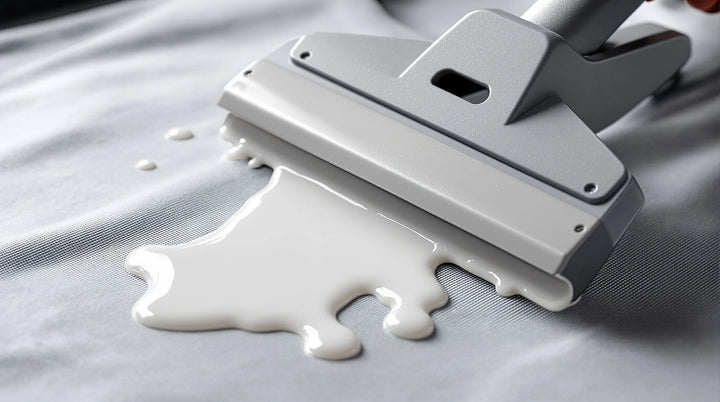
A screen is a fine mesh pulled tight over a frame and coated with a light-sensitive emulsion. Your artwork is separated into its individual colors, each one output as solid black on a clear film, and that film is laid over the coated screen and exposed to UV light. Wherever the light reaches, the emulsion hardens. Wherever the black artwork blocks it, the emulsion stays soft and rinses straight out under water, leaving open mesh in the exact shape of that one color. On press, ink is flooded across the screen and a squeegee is drawn over it under pressure, forcing ink through the open threads and onto the garment underneath.
One color, one screen. A two-color logo means two screens, two setups, and two passes, which is why color count moves the price of a screen-printed job as much as quantity does, and why most screen-printed jobs sit between one and four colors. Each screen locks into its own station on the press and is registered against the others so every layer lands exactly where it belongs. Mesh count matters as well. A coarse mesh of about 110 threads per inch lets a heavy deposit through and is what gets solid, opaque white onto a black shirt. Around 156 is the everyday workhorse for general production. Fine mesh at 230 and above holds thinner ink and the small halftone dots that detail work needs.
Plastisol is the standard ink and what most jobs use. It is opaque, bright, and forgiving, it will not dry in the screen while the press is idle, and it prints on cotton, polyester, and blends without the pretreatment a direct-to-garment machine requires. It sits as a thin film on top of the fabric, so you can feel it, and it does not air-dry: it has to be brought to temperature, roughly 320 degrees Fahrenheit right through the ink film, to fuse properly. Water-based ink works the opposite way, soaking into the fibers and becoming part of the shirt for a print you genuinely cannot feel, traded against a softer, less opaque look and a fussier process. Discharge is the water-based route for dark garments: an activator lifts the shirt's own dye and leaves color in its place, so even a heavy print on a black tee stays soft. Discharge has real limits worth knowing: it wants 100 percent cotton dyed with reactive dyes, blends discharge unevenly because polyester fibers hold no dye to remove, and some garment colors, royals and reds especially, come back a muddier shade than the swatch suggested.
Cotton and cotton-rich blends are where screen printing is happiest, which covers most tees, fleece, and canvas totes. Polyester performance wear prints well too, but it needs handling: the heat used to cure the ink can reactivate the garment's own dye and let it creep up into the print, turning a white logo pink on a red jersey days after printing. The answer is a low-cure or low-bleed ink and, on dark saturated colors, a blocker underbase between fabric and artwork. Garment-dyed and over-dyed goods carry the same risk and get the same treatment. Durability, in the end, comes down almost entirely to cure: a print taken fully up to temperature bonds properly and normally survives the working life of the garment, while the prints that crack and flake after a few washes are under-cured ones.
Get a Free Printing Quote
Send your artwork, garment, and quantity: a firm quote and a digital proof for your DTF print come back, usually the same day.
Get My PrintingWhat Can Be Screen Printed
If it is a flat, printable panel on a garment or a bag, it can usually be screen printed. These are the pieces people screen print most often:
- T-shirts — cotton and cotton-blend tees, the garment screen printing was built for. Event shirts, camp and church runs, merch drops, and anything where a hundred people need to look like one group.
- Hoodies & fleece — heavyweight pullovers and zip-ups. A thicker ink deposit through a coarser mesh keeps the print sitting on top of the nap instead of sinking into it.
- Team jerseys & performance wear — polyester athletic garments, printed with low-bleed inks and a blocker underbase so numbers and names stay the color you ordered.
- Tote bags & canvas — cotton canvas takes a bold one- or two-color print beautifully, which is why totes are such a popular giveaway at volume.
- Staff uniforms & workwear — polos, work tees, and aprons with a left-chest logo and a full back panel, reordered from the same screens as staff turn over.
- Youth, school & league orders — matched adult and youth sizing in a single run, printed once so every size looks the same on the field.
Two honest limits are worth stating up front. Screen printing is a spot-color process: it is built for bold shapes, clean type, and flat areas of color, and every extra color is another screen and another setup. Photographs, soft gradients, and full-color illustration can be screen printed through halftones, but the screen count climbs fast and the economics stop making sense. That is exactly where DTF, the method we print with, takes over: every color prints at once, from a single shirt up. And the garment sets the ceiling on the finish: a soft ringspun cotton tee holds fine detail that a heavy canvas tote simply will not.
Not sure which blank suits the job? Tell us the budget, the count, and where the shirts are going, and we will put two or three sensible options in front of you, each printed with DTF and priced.
Find Your City
We print for customers right across Miami-Dade and Broward, so pick your city below for the local pickup, delivery, and turnaround details that apply to you.
Not on the list? We cover a good deal more of South Florida than these cities alone — see all the areas we serve, or simply ask when you request your quote.
Pricing & Turnaround
Three things set the price of a screen-printed order: the garment itself, the number of colors in the design, and how many pieces you are running. The garment is the straightforward part — a basic cotton tee and a heavyweight zip hoodie are different products at different costs. Colors are the part people underestimate, because each one is a separate screen to burn, a separate station to register, and a separate pass through the press, so a four-color front costs meaningfully more to set up than a one-color front on the same shirt. Quantity is where all of that gets absorbed.
Here is the economics in one sentence: setup happens once, no matter how many shirts follow it. The screens for a job cost the same to make for twelve pieces as for twelve hundred, so on a tiny run that fixed cost lands on very few shirts and the per-piece price looks steep, while on a large run it thins out until the garment and the ink are almost all you are paying for. Across the industry the per-piece cost of a simple design falls several times over between a couple of dozen pieces and a few hundred, and that curve is the reason screen printing has stayed the default for large uniform, event and merch runs.
On minimums, screen printing has a practical floor rather than a policy one: below roughly a dozen pieces the setup dominates the bill and you are paying for screens instead of shirts. That floor is the main reason we print DTF. A DTF transfer needs no screens, so a small run is not penalized, every color in the artwork prints at once, and the design can change from shirt to shirt. We quote every order directly rather than publishing a price table, because your actual garment, artwork, and count decide the price.
Most of our orders are ready in 1 to 10 days, depending on order size, with the clock starting at proof approval rather than at first contact. Multiple print locations and blanks we have to bring in can add time, so tell us the date you need them by at the very start and we will build the schedule backward from it. Reorders are the quiet advantage: your artwork stays on file, so a repeat run skips the artwork round and comes back matching the first batch, which matters when you are topping up staff shirts in March that were printed in October.
Ready to Get Your Shirts Printed?
Request your free quote: most orders are ready in 1 to 10 days, depending on order size.
Get My PrintingHow to Order Your Printing
Ordering is straightforward, and nothing is printed until you have approved a proof:
- Send your design and your numbers. Give us the artwork, the garment you have in mind, the quantity, and a size breakdown through our free quote form or by WhatsApp at (954) 932-8543. Artwork not print-ready, or only a photo of an old shirt? Send it anyway: cleaning up files for print is part of the job.
- Review your quote and proof. A firm, itemized quote comes back with the garment, the print size, and the quantity broken out, alongside a digital proof showing the print at actual size and placement. Usually the same day. Nothing moves until you are happy with it.
- Approve, and we print. Once you sign off we print your design as DTF transfers and heat-press them onto your garments in-house at our Hallandale Beach shop. Most orders are ready in 1 to 10 days, depending on order size.
- Pick it up or have it delivered. Free local pickup at 389 NE 2nd Ave, Hallandale Beach — or we will ship it, or arrange local delivery anywhere across Miami-Dade and Broward.
Need the same shirts again next season? Your artwork stays on file, so a reorder skips straight to production and matches the run before it, down to the colors and the placement.
Get Your Custom Printing Quote
Fast turnaround, competitive pricing, free local delivery in South Florida.
Request a QuoteRequest a Custom Printing Quote — South Florida
Tell us about your order and we'll get back to you within 1 business day.
Custom Screen Printing in South Florida — frequently asked questions
Is there a minimum order for screen printing?
Screen printing has no policy minimum but a practical one: screens and press setup cost the same for twelve pieces or twelve hundred, so it usually becomes economical at around two dozen pieces of one design. Adorb doesn't run screen printing. We print DTF transfers, which need no screens, so there is no minimum with us: one shirt is a normal order.
What garments and fabrics can be screen printed?
Cotton and cotton-rich blends are the natural fit for screen printing, which covers T-shirts, hoodies and fleece, canvas tote bags, work tees, aprons, and most youth and school apparel. Polyester performance wear and team jerseys can be screen printed too, but need low-bleed or low-cure ink and often a blocker underbase. The DTF transfers we print bond to cotton, polyester, blends and performance wear alike; tell us the exact blank and we will confirm before you commit.
How long does an order take?
Most of our orders are ready in 1 to 10 days, depending on order size, and the clock starts at proof approval. If you have a fixed date, such as an event, a game or a store opening, say so at the start and we will work backward from it and tell you straight away what is realistic.
Should I choose screen printing, DTF, or DTG?
Screen printing suits large runs of simple spot-color designs: setup is paid once and spread across the run, and the ink lays down thick and opaque. DTG prints into cotton for a very soft, photo-quality result on small runs of light cotton. DTF transfers need no screens, print full color including gradients and photographs, and bond to almost any fabric. DTF is what we print in-house, and it covers the jobs people usually bring to either of the other two, from one shirt to a large run.
What areas do you serve?
We print for customers throughout Miami-Dade and Broward, including Miami, Hialeah, Fort Lauderdale, Pembroke Pines, Hollywood, Miramar, Aventura, Coral Gables, Doral, Weston, Pompano Beach, and everywhere in between. Our shop is at 389 NE 2nd Ave in Hallandale Beach, right on the county line, so free local pickup is convenient for most of South Florida. We also ship and can arrange local delivery.
How many colors can a design have, and can a photograph be printed?
In screen printing each color needs its own screen, registration and press pass, so color count drives the price as much as quantity does, and photographs need halftones that get expensive fast. With DTF, which is how we print, every color prints at once, so a photograph or a gradient costs no more to set up than a one-color logo. On care: wash inside out in cold water, tumble dry low or hang, and never iron directly over the print.
Our shop
Visit our Hallandale Beach shop
389 NE 2nd Ave, Hallandale Beach, FL 33009
Pickup and drop-off at the shop, right on the Miami-Dade and Broward line.
Order Custom Printing in South Florida today
Call, WhatsApp, or fill out the quote form. We'll handle the rest — artwork, printing, and local pickup.
